








A factual timeline for a Title IX response helps investigators follow the events and the supporting evidence. Investigators review many messages, interviews, and records. A clean chronological timeline helps the reader follow what happened, what is documented, and what remains unknown.
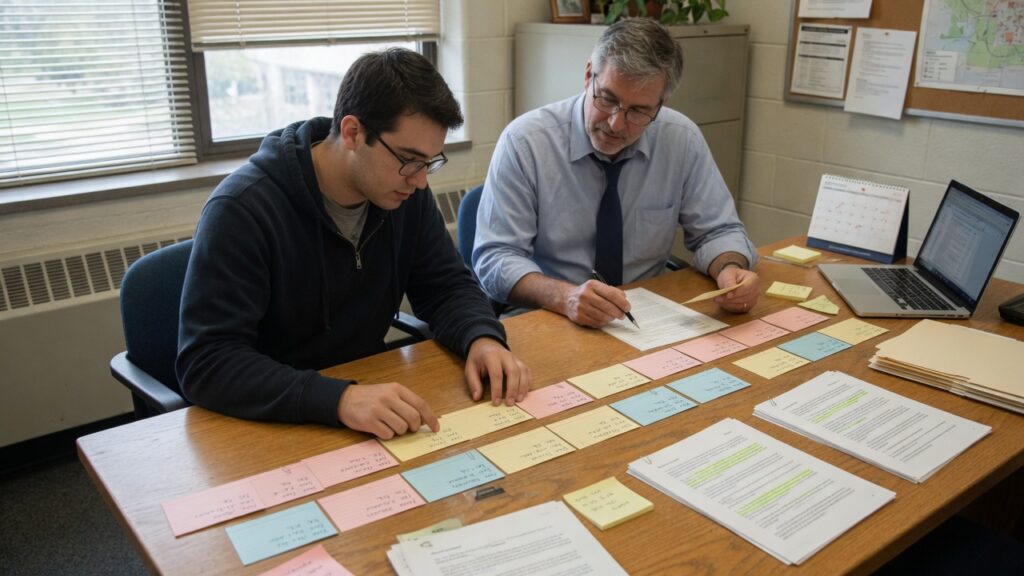
This article describes an organization workflow, not a technology product or a legal conclusion. It fits within the evidence review windows in the grievance process for covered sexual-harassment complaints. A Title IX defense lawyer can help assess how a timeline fits the written campus policy and the current record.
Anchor Events Before Filling Details
Start With Fixed Points From Independent Sources
Begin with events tied to records that carry their own timestamps. Examples include class schedules, work shifts, card swipes, reservation confirmations, and messages that show carrier timestamps. Place those anchors first, then arrange other events around them.
Use one row per event with date, approximate time, location, persons present, and source. Where time is uncertain, state the range and the basis for the estimate. A short entry that admits uncertainty reads as more reliable than a precise entry without support.
Separate Observed Facts From Inferences
Keep three columns or fields distinct. The first states what was directly observed. The second states the source that supports it. The third states any inference or context, clearly labeled as such. This separation helps during evidence review because investigators can test each link.
Avoid filling gaps with assumed motives or assumed travel times. Where movement between places matters, record the addresses and the source for each endpoint, then note the gap. Additional detail on digital evidence appears in the page on technology and social media in Title IX cases.
Build the Record With Contemporaneous Sources
Collect Messages Photos and Logs in Original Form
Contemporaneous records often carry more weight than later summaries because they were created before the dispute. Useful sources include texts, call logs, photos with metadata, receipts, class and work records, and portal notices. Save originals before exporting copies for review.
The federal process requires that parties receive the evidence subject to inspection and have at least 10 days to submit a written response before the investigative report is completed. That right appears in the 2020 grievance process text. Penn State mirrors that window in its Policy AD85, stating that parties have ten days to submit a written response. Ohio State sets ten business days in its misconduct policy, which shows why the campus policy controls the exact count.
Number Exhibits and Cite Them Consistently
Assign each document a stable exhibit number at the start, such as Exhibit 1 or Exhibit 2, and keep a one line index with date, author, and description. Cite the same number every time the document appears in the timeline or response. Avoid renumbering late in the process because cross references break.
Quote short passages exactly where wording matters. Do not paraphrase policy clauses or key messages where precision counts. Where a full thread matters, include the surrounding messages so the excerpt keeps its context.
Mind Gaps Edits and Credibility Risks
Keep a Gap Log Instead of Guessing
Every timeline has gaps. Phones die, memories blur, and cameras miss angles. A gap log lists each missing interval, what was sought, and the result. Examples include a ride record that could not be retrieved, a message thread with a missing week, or a witness whose contact details are unknown.
A clear gap log protects credibility. It shows the reader what was checked and avoids the impression that unfavorable material was hidden. Update the log as new records arrive during the review windows.
Never Edit Originals or Recreate Records
Do not alter screenshots, trim videos to change meaning, rewrite notes after the fact, or ask others to delete or backdate material. The Department enforcement posture treats the 2020 rule as the operative text, as stated on the OCR enforcement page. The grievance process in the Section 106.45 text then tests the record through inspection, response, report review, hearing, and appeal.
Work only on copies. Keep originals intact with filenames, dates, and custodians noted. Where a copy must be redacted for a lawful reason, label it as a redacted copy and keep the unredacted original available for counsel review.
Checklist for a Response Ready Timeline
Follow these steps in order. Keep the file clean enough that a new reader can follow it without explanation.
- Fix anchors first. Enter independently timestamped events with sources before adding recollections.
- Add contemporaneous records. Attach messages, logs, receipts, and notices in original form with dates.
- Label every inference. Mark opinions, estimates, and reconstructions as such and keep them apart from observed facts.
- Log gaps openly. List each missing interval, each search tried, and each result, then update the log as records arrive.
- Number and cite exhibits. Use stable numbers, one index, exact short quotes, and consistent citations in the written response.
Frequently Asked Questions About a Factual Timeline for a Title IX Response
How detailed should each timeline entry be?
Include date, time or time range, location, persons present, what occurred, and the supporting source. Add the exhibit number where a document supports the entry. Keep each entry to facts that a source can support.
What should I do about time gaps I cannot fill?
Record the gap, state what was checked, and note the result. Avoid estimates presented as exact times. An honest gap log reads better than a forced reconstruction.
Can I clean up messages before producing them?
No. Preserve originals and work on copies. Edits, deletions, and selective screenshots create credibility and conduct risk. Let counsel decide what to submit and how to frame it.
When should the timeline be finished?
Build a working version early, then refine it during the evidence inspection window and again after the investigative report arrives. Confirm both review periods in the campus policy so no window is missed.
To discuss how to organize a timeline under a specific campus policy, contact the defense team for guidance tailored to the current record.
Disclaimer: This article provides general information and is not legal advice. Rules and deadlines depend on the institution, jurisdiction, and circumstances. Reading this article or contacting the firm does not by itself create an attorney-client relationship.